 7e2be02c26
* cmd, core, trie: verkle-capable `geth init` (#28270)

This change allows the creation of a genesis block for verkle testnets. This makes for a chunk of code that is easier to review and still touches many discussion points.

* eth/tracers/js: fix isPush for push0 (#28520)

Fixes so that `push0` opcode is correctly reported as `true` by the `IsPush` function

---------

Co-authored-by: Martin Holst Swende <martin@swende.se>

* trie: spelling - fix comments in hasher (#28507)

Co-authored-by: VM <arimas@foxmail.com>

* tests/fuzzers: move fuzzers into native packages (#28467)

This PR moves our fuzzers from tests/fuzzers into whatever their respective 'native' package is.

The historical reason why they were placed in an external location, is that when they were based on go-fuzz, they could not be "hidden" via the _test.go prefix. So in order to shove them away from the go-ethereum "production code", they were put aside.

But now we've rewritten them to be based on golang testing, and thus can be brought back. I've left (in tests/) the ones that are not production (bls128381), require non-standard imports (secp requires btcec, bn256 requires gnark/google/cloudflare deps).

This PR also adds a fuzzer for precompiled contracts, because why not.

This PR utilizes a newly rewritten replacement for go-118-fuzz-build, namely gofuzz-shim, which utilises the inputs from the fuzzing engine better.

* tests: skip tests on windows 32bit CI (#28521)

tests: skip half the blockchain- and state-tests on windows 32bit CI-tests

* cmd/geth: more special cases logging tests (#28527)

adds logging tests for errors and custom fmt.Stringer-types which output strings that needs to be quoted/escaped.

* accounts,cmd,console,les,metrics:  refactor some errors checked by (ST1005) go-staticcheck (#28532)

fix: fix some (ST1005)go-staticcheck

* miner: run tests in parallel (#28506)

Changes many of the tests in the miner package to run in parallel

* internal/jsre/deps: fix typo in jsdoc (#28511)

minor typo fix

* accounts/abi: improve readability of method-to-string conversion  (#28530)

refactor: improve readability of NewMethod print

* all: replace some cases of strings.SplitN with strings.Cut (#28446)

* ethdb/memorydb, trie: reduced allocations (#28473)

* trie: use pooling of iterator states in iterator

The node iterator burns through a lot of memory while iterating a trie, and a lot of
that can be avoided by using a fairly small pool (max 40 items).

name        old time/op    new time/op    delta
Iterator-8    6.22ms ± 3%    5.40ms ± 6%  -13.18%  (p=0.008 n=5+5)

name        old alloc/op   new alloc/op   delta
Iterator-8    2.36MB ± 0%    1.67MB ± 0%  -29.23%  (p=0.008 n=5+5)

name        old allocs/op  new allocs/op  delta
Iterator-8     37.0k ± 0%     29.8k ± 0%     ~     (p=0.079 n=4+5)

* ethdb/memorydb: avoid one copying of key

By making the transformation from []byte to string at an earlier point,
we save an allocation which otherwise happens later on.

name           old time/op    new time/op    delta
BatchAllocs-8     412µs ± 6%     382µs ± 2%   -7.18%  (p=0.016 n=5+4)

name           old alloc/op   new alloc/op   delta
BatchAllocs-8     480kB ± 0%     490kB ± 0%   +1.93%  (p=0.008 n=5+5)

name           old allocs/op  new allocs/op  delta
BatchAllocs-8     3.03k ± 0%     2.03k ± 0%  -32.98%  (p=0.008 n=5+5)

* Dockerfile: update Go to 1.21 (#28538)

* cmd/evm: validate blockchain tests poststate account storage (#28443)

This PR verifies the accounts' storage as specified in a blockchain test's postState field

The expect-section, it does really only check that the test works. It's meant for the test-author to verify that "If the test does what it's supposed to, then the nonce of X should be 2, and the slot Y at Z should be 0x123.

    This expect-section is not exhaustive (not full post-state)
    It is also not auto-generated, but put there manually by the author.

We can still check it, as a test-sanity-check, in geth

* signer: run tests in parallel (#28536)

marks tests as parallel-safe in package signer

* accounts, cmd: fix typos (#28526)

* core/txpool/legacypool: respect nolocals-setting (#28435)

This change adds a check to ensure that transactions added to the legacy pool are not treated as 'locals' if the global locals-management has been disabled.

This change makes the pool enforce the --txpool.pricelimit setting.

* cmd: run tests in parallel (#28546)

* core/state/snapshot: print correct error from trie iterator (#28560)

* cmd/evm: capitalize evm commands (#28569)

* standard:fix for a unified standard

* standard:fix more as a complements

---------

Co-authored-by: haotian <haotian@haotiandeMacBook-Air.local>

* accounts/abi: context info on unpack-errors (#28529)

adds contextual information to errors returned by unpack

* core, trie, rpc: speed up tests (#28461)

* rpc: make subscription test faster

reduces time for TestClientSubscriptionChannelClose
from 25 sec to < 1 sec.

* trie: cache trie nodes for faster sanity check

This reduces the time spent on TestIncompleteSyncHash
from ~25s to ~16s.

* core/forkid: speed up validation test

This takes the validation test from > 5s to sub 1 sec

* core/state: improve snapshot test run
brings the time for TestSnapshotRandom from 13s down to 6s

* accounts/keystore: improve keyfile test

This removes some unnecessary waits and reduces the
runtime of TestUpdatedKeyfileContents from 5 to 3 seconds

* trie: remove resolver
* trie: only check ~5% of all trie nodes

* ethdb/pebble: don't double-close iterator inside pebbleIterator (#28566)

Adds 'released' flag to pebbleIterator to avoid double closing cockroachdb/pebble.Iterator as it is an invalid operation.

Fixes #28565

* eth/filters: reuse error msg for invalid block range (#28479)

* core/types: make 'v' optional for DynamicFeeTx and BlobTx (#28564)

This fixes an issue where transactions would not be accepted when they have only
'yParity' and not 'v'.

* rpc: improve performance of subscription notification encoding (#28328)

It turns out that encoding json.RawMessage is slow because
package json basically parses the message again to ensure it is valid.
We can avoid the slowdown by encoding the entire RPC notification once,
which yields a 30% speedup.

* cmd/utils: validate pre-existing genesis in --dev mode (#28468)

geth --dev can be used with an existing data directory and genesis block. Since
dev mode only works with PoS, we need to verify that the merge has happened.

Co-authored-by: Felix Lange <fjl@twurst.com>

* cmd/geth: add support for --dev flag in dumpgenesis (#28463)


Co-authored-by: Felix Lange <fjl@twurst.com>
Co-authored-by: lightclient <lightclient@protonmail.com>

* les/vflux: run tests in parallel (#28524)

* cmd/{geth,utils}: add cmd to export preimages in snap enumeration order (#28256)

Adds a subcommand: `geth snapshot export-preimages`, to export preimages of every hash found during a snapshot enumeration: that is, it exports _only the active state_, and not _all_ preimages that have been used but are no longer part of the state.

This tool is needed for the verkle transition, in order to distribute the preimages needed for the conversion. Since only the 'active' preimages are exported, the output is shrunk from ~70GB to ~4GB.

The order of the output is the order used by the snapshot enumeration, which avoids database thrashing. However, it also means that storage-slot preimages are not deduplicated.

* cmd/geth: fix build error (#28585)

* cmd/devp2p/internal/ethtest: undo debug-hack (#28588)

cmd/devp2p/internal/ethtest: remove a debug-hack flaw which prevented certain tests from running

* params: update discV5 bootnodes (#28562)

update discV5 bootnodes from https://github.com/eth-clients/eth2-networks/blob/master/shared/mainnet/bootstrap_nodes.txt

* cmd, les, tests: remove light client code (#28586)

* cmd, les, tests: remove light client code

This commit removes the light client (LES) code.
Since the merge the light client has been broken and
it is hard to maintain it alongside the normal client.
We decided it would be best to remove it for now and
maybe rework and reintroduce it in the future.

* cmd, eth: remove some more mentions of light mode

* cmd: re-add flags and mark as deprecated

* cmd: warn the user about deprecated flags

* eth: better error message

* eth, internal/ethapi: drop some weird indirection (#28597)

* trie: fix random test generator early terminate (#28590)

This change fixes a minor bug in the `randTest.Generate` function, which caused the `quick.Check` to be a no-op.

* eth/gasestimator, internal/ethapi: move gas estimator out of rpc (#28600)

* go.mod: update uint256 to v1.2.4 (#28612)

* eth/catalyst, eth/downloader: expose more sync information (#28584)

This change exposes more information from sync module internally

* light: remove package light(#28614)

This changes removes the package 'light', which is currently unused.

* cmd/evm, core/state: fix post-exec dump of state (statetests, blockchaintests) (#28504)

There were several problems related to dumping state.

- If a preimage was missing, even if we had set the `OnlyWithAddresses` to `false`, to export them anyway, the way the mapping was constructed (using `common.Address` as key) made the entries get lost anyway. Concerns both state- and blockchain tests.
- Blockchain test execution was not configured to store preimages.

This changes makes it so that the block test executor takes a callback, just like the state test executor already does. This callback can be used to examine the post-execution state, e.g. to aid debugging of test failures.

* ethereum: remove TODO comment about subscription (#28609)

* eth/tracers/js: fix type inconsistencies (#28488)

This change fixes two type-inconsistencies in the JS tracer:

- In most places we return byte arrays as a `Uint8Array` to the tracer. However it seems we missed doing the conversion for `ctx` fields which are passed to the tracer during `result`. They are passed as simple arrays. I think Uint8Arrays are more suitable and we should change this inconsistency. Note: this will be a breaking-change. But I believe the effect is small. If we look at our tracers we see that these fields (`ctx.from`, `ctx.to`, etc.) are used in 2 ways. Passed to `toHex` which takes both array or buffer. Or the length was measured which is the same for both types.
- The `slice` taking in `int, int` params versus `memory.slice` taking `int64, int64` params. I suggest changing `slice` types to `int64`. This should have no effect almost in any case.

* crypto/secp256k1: fix 32-bit tests when CGO_ENABLED=0 (#28602)

* consensus: verify the nonexistence of shanghai- and cancun-specific header fields (#28605)

* eth/gasestimator: allow slight estimation error in favor of less iterations (#28618)

* eth/gasestimator: early exit for plain transfer and error allowance

* core, eth/gasestimator: hard guess at a possible required gas

* internal/ethapi: update estimation tests with the error ratio

* eth/gasestimator: I hate you linter

* graphql: fix gas estimation test

---------

Co-authored-by: Oren <orenyomtov@users.noreply.github.com>

* all: replace log15 with slog (#28187)

This PR replaces Geth's logger package (a fork of [log15](https://github.com/inconshreveable/log15)) with an implementation using slog, a logging library included as part of the Go standard library as of Go1.21.

Main changes are as follows:
* removes any log handlers that were unused in the Geth codebase.
* Json, logfmt, and terminal formatters are now slog handlers.
* Verbosity level constants are changed to match slog constant values.  Internal translation is done to make this opaque to the user and backwards compatible with existing `--verbosity` and `--vmodule` options.
* `--log.backtraceat` and `--log.debug` are removed.

The external-facing API is largely the same as the existing Geth logger.  Logger method signatures remain unchanged.

A small semantic difference is that a `Handler` can only be set once per `Logger` and not changed dynamically.  This just means that a new logger must be instantiated every time the handler of the root logger is changed.

----
For users of the `go-ethereum/log` module. If you were using this module for your own project, you will need to change the initialization. If you previously did
```golang
log.Root().SetHandler(log.LvlFilterHandler(log.LvlInfo, log.StreamHandler(os.Stderr, log.TerminalFormat(true))))
```
You now instead need to do
```golang
log.SetDefault(log.NewLogger(log.NewTerminalHandlerWithLevel(os.Stderr, log.LevelInfo, true)))
```
See more about reasoning here: https://github.com/ethereum/go-ethereum/issues/28558#issuecomment-1820606613

* core/state: make stateobject.create selfcontain (#28459)

* trie/triedb/hashdb: take lock around access to dirties cache (#28542)

Add read locking of db lock around access to dirties cache in hashdb.Database to prevent
data race versus hashdb.Database.dereference which can modify the dirities map by deleting
an item.

Fixes #28541

---------

Co-authored-by: Gary Rong <garyrong0905@gmail.com>

* accounts/abi/bind: fix typo (#28630)

* slog: faster and less memory-consumption (#28621)

These changes improves the performance of the non-coloured terminal formatting, _quite a lot_.

```
name               old time/op    new time/op    delta
TerminalHandler-8    10.2µs ±15%     5.4µs ± 9%  -47.02%  (p=0.008 n=5+5)

name               old alloc/op   new alloc/op   delta
TerminalHandler-8    2.17kB ± 0%    0.40kB ± 0%  -81.46%  (p=0.008 n=5+5)

name               old allocs/op  new allocs/op  delta
TerminalHandler-8      33.0 ± 0%       5.0 ± 0%  -84.85%  (p=0.008 n=5+5)
```

I tried to _somewhat_ organize the commits, but the it might still be a bit chaotic. Some core insights:

- The function `terminalHandler.Handl` uses a mutex, and writes all output immediately to 'upstream'. Thus, it can reuse a scratch-buffer every time.
- This buffer can be propagated internally, making all the internal formatters either write directly to it,
- OR, make  use of the `tmp := buf.AvailableBuffer()` in some cases, where a byte buffer "extra capacity" can be temporarily used.
- The `slog` package  uses `Attr` by value. It makes sense to minimize operating on them, since iterating / collecting into a new slice, iterating again etc causes copy-on-heap. Better to operate on them only once.
- If we want to do padding, it's better to copy from a constant `space`-buffer than to invoke `bytes.Repeat` every single time.

* eth/tracers: tx-level state in debug_traceCall (#28460)

* cmd/evm: fix Env struct json tag (#28635)

* accounts/abi/bind: fixed typos (#28634)

* Update auth.go

* Update backend.go

* Update bind.go

* Update bind_test.go

* eth/fetcher: fix invalid tracking of received at time for block (#28637)

eth/fetcher: fix invalid tracking of received at time

* accounts: run tests in parallel (#28544)

* eth/tracers/logger: make structlog/json-log stack hex again (#28628)

* common/hexutil: define hex wrappers for uint256.Int

* eth/tracers/logger: make structlog/json-log stack hex again

* common/hexutil: goimports

* log: remove lazy, remove unused interfaces, unexport methods (#28622)

This change

- Removes interface `log.Format`,
- Removes method `log.FormatFunc`,
- unexports `TerminalHandler.TerminalFormat` formatting methods (renamed to `TerminalHandler.format`)
- removes the notion of `log.Lazy` values


The lazy handler was useful in the old log package, since it
could defer the evaluation of costly attributes until later in the
log pipeline: thus, if the logging was done at 'Trace', we could
skip evaluation if logging only was set to 'Info'.

With the move to slog, this way of deferring evaluation is no longer
needed, since slog introduced 'Enabled': the caller can thus do
the evaluate-or-not decision at the callsite, which is much more
straight-forward than dealing with lazy reflect-based evaluation.

Also, lazy evaluation would not work with 'native' slog, as in, these
two statements would be evaluated differently:

```golang
  log.Info("foo", "my lazy", lazyObj)
  slog.Info("foo", "my lazy", lazyObj)
```

* .github: use github actions to run 32-bit linux tests (#28549)

use github actions to run 32-bit linux tests

* ethdb/pebble: remove a dependency (#28627)

The dependency was not really used anyway, so we can get rid of it.

Co-authored-by: Felix Lange <fjl@twurst.com>

* tests/fuzzers/bls12381: deactivate BLS fuzzer when CGO_ENABLED=0 (#28653)

tests/fuzzers/bls12381: deactivate fuzzer when CGO_ENABLED=0

* build: upgrade -dlgo version to Go 1.21.5 (#28648)

* rpc: fix ns/µs mismatch in metrics (#28649)

The rpc/duration/all meter was in nanoseconds, the individual meter in microseconds.
This PR changes it so both of them use nanoseconds.

* cmd/evm: fix dump after state-test exec (#28650)

The dump after state-test didn't work, the problem was an error, "Already committed", which was silently ignored.

This change re-initialises the state, so the dumping works again.

* beacon/light: add CommitteeChain (#27766)

This change implements CommitteeChain which is a key component of the beacon light client. It is a passive data structure that can validate, hold and update a chain of beacon light sync committees and updates, starting from a checkpoint that proves the starting committee through a beacon block hash, header and corresponding state. Once synced to the current sync period, CommitteeChain can also validate signed beacon headers.

* cmd/utils, eth: disallow invalid snap sync / snapshot flag combos (#28657)

* eth: prevent startup in snap mode without snapshots

* cmd/utils: try to fix bad flag combos wrt snap sync and snapshot generation

* trie: remove inconsistent trie nodes during sync in path mode (#28595)

This fixes a database corruption issue that could occur during state healing.
When sync is aborted while certain modifications were already committed, and a
reorg occurs, the database would contain incorrect trie nodes stored by path.
These nodes need to detected/deleted in order to obtain a complete and fully correct state
after state healing.

---------

Co-authored-by: Felix Lange <fjl@twurst.com>

* cmd/utils: fix HTTPHost, WSHost flag priority (#28669)


Co-authored-by: Felix Lange <fjl@twurst.com>

* eth/protocols/eth: fix typos in comments (#28652)

* core/txpool : small cleanup refactors (#28654)

* eth/fetcher, eth/gasestimator: fix typos in comments (#28675)

* all: fix typos in comments (#28662)


Co-authored-by: Felix Lange <fjl@twurst.com>

* miner: eliminate the dead loop possibility for `newWorkLoop` and `mainLoop` (#28677)

discard the intervalAdjust message if the channel is full

* all: fix typos in comments (#28682)

chore(core,eth):fix a couple of typos

* p2p/discover: add liveness check in collectTableNodes (#28686)

* p2p/discover: add liveness check in collectTableNodes

* p2p/discover: fix test

* p2p/discover: rename to appendLiveNodes

* p2p/discover: add dedup logic back

* p2p/discover: simplify

* p2p/discover: fix issue found by test

* internal/flags: add missing flag types for auto-env-var generation (#28692)

Certain flags, such as `--rpc.txfeecap` currently do not have an env-var auto-generated for them. This change adds three missing cli flag types to the auto env-var helper function to fix this.

* cmd/evm:  default to mirror mainnet forks enabled (#28691)

cmd/evm:  default to using dev chain config (all mainnet HFs activated at block/timestamp 0

* cmd/evm, cmd/clef, cmd/bootnode: fix / unify logging (#28696)

This change fixes a problem with our non-core binaries: evm, clef, bootnode.

First of all, they failed to convert from legacy loglevels 1 to 5, to the new slog loglevels -4 to 4.

Secondly, the logging was actually setup in the init phase, and then overridden in the main. This is not needed for evm, since it used the same flag name as the main geth verbosity. Better to let the flags/internal handle the logging init.

* cmd/evm: t8n support custom tracers (#28557)

This change implements ability for the `evm t8n` tool to use custom tracers; either 'native' golang tracers or javascript tracers.

* params: release go-ethereum v1.13.6 stable

* Fix build errors

* Fix test-integration

---------

Co-authored-by: Guillaume Ballet <3272758+gballet@users.noreply.github.com>
Co-authored-by: Sina Mahmoodi <1591639+s1na@users.noreply.github.com>
Co-authored-by: Martin Holst Swende <martin@swende.se>
Co-authored-by: VM <112189277+sysvm@users.noreply.github.com>
Co-authored-by: VM <arimas@foxmail.com>
Co-authored-by: jwasinger <j-wasinger@hotmail.com>
Co-authored-by: Zoro <40222601+BabyHalimao@users.noreply.github.com>
Co-authored-by: Håvard Anda Estensen <haavard.ae@gmail.com>
Co-authored-by: aliening <128203330+aliening@users.noreply.github.com>
Co-authored-by: Halimao <1065621723@qq.com>
Co-authored-by: danceratopz <danceratopz@gmail.com>
Co-authored-by: levisyin <150114626+levisyin@users.noreply.github.com>
Co-authored-by: jp-imx <109574657+jp-imx@users.noreply.github.com>
Co-authored-by: rjl493456442 <garyrong0905@gmail.com>
Co-authored-by: Haotian <51777534+tmelhao@users.noreply.github.com>
Co-authored-by: haotian <haotian@haotiandeMacBook-Air.local>
Co-authored-by: Marius van der Wijden <m.vanderwijden@live.de>
Co-authored-by: Maciej Kulawik <10907694+magicxyyz@users.noreply.github.com>
Co-authored-by: ucwong <ucwong@126.com>
Co-authored-by: Mario Vega <marioevz@gmail.com>
Co-authored-by: Delweng <delweng@gmail.com>
Co-authored-by: Felix Lange <fjl@twurst.com>
Co-authored-by: lightclient <lightclient@protonmail.com>
Co-authored-by: Mikel Cortes <45786396+cortze@users.noreply.github.com>
Co-authored-by: Péter Szilágyi <peterke@gmail.com>
Co-authored-by: Ng Wei Han <47109095+weiihann@users.noreply.github.com>
Co-authored-by: lightclient <14004106+lightclient@users.noreply.github.com>
Co-authored-by: Shivam Sandbhor <shivam.sandbhor@gmail.com>
Co-authored-by: Jakub Freebit <49676311+jakub-freebit@users.noreply.github.com>
Co-authored-by: Oren <orenyomtov@users.noreply.github.com>
Co-authored-by: BorkBorked <107079055+BorkBorked@users.noreply.github.com>
Co-authored-by: ddl <dengdiliang@gmail.com>
Co-authored-by: Manav Darji <manavdarji.india@gmail.com>
Co-authored-by: Marius Kjærstad <sandakersmann@users.noreply.github.com>
Co-authored-by: Felföldi Zsolt <zsfelfoldi@gmail.com>
Co-authored-by: Ford <153042616+guerrierindien@users.noreply.github.com>
Co-authored-by: Ursulafe <152976968+Ursulafe@users.noreply.github.com>
Co-authored-by: Elias Rad <146735585+nnsW3@users.noreply.github.com>
Co-authored-by: FletcherMan <fanciture@163.com>
Co-authored-by: alex <152680487+bodhi-crypo@users.noreply.github.com>
Co-authored-by: Sebastian Stammler <seb@oplabs.co>
30 KiB
Clef
Clef can be used to sign transactions and data and is meant as a(n eventual) replacement for Geth's account management. This allows DApps to not depend on Geth's account management. When a DApp wants to sign data (or a transaction), it can send the content to Clef, which will then provide the user with context and asks for permission to sign the content. If the users grants the signing request, Clef will send the signature back to the DApp.
This setup allows a DApp to connect to a remote Ethereum node and send transactions that are locally signed. This can help in situations when a DApp is connected to an untrusted remote Ethereum node, because a local one is not available, not synchronized with the chain, or is a node that has no built-in (or limited) account management.
Clef can run as a daemon on the same machine, off a usb-stick like USB armory, or even a separate VM in a QubesOS type setup.
Check out the
- CLI tutorial for some concrete examples on how Clef works.
- Setup docs for information on how to configure Clef on QubesOS or USB Armory.
- Data types for details on the communication messages between Clef and an external UI.
Command line flags
Clef accepts the following command line options:
COMMANDS:
   init    Initialize the signer, generate secret storage
   attest  Attest that a js-file is to be used
   setpw   Store a credential for a keystore file
   delpw   Remove a credential for a keystore file
   gendoc  Generate documentation about json-rpc format
   help    Shows a list of commands or help for one command

GLOBAL OPTIONS:
   --loglevel value        log level to emit to the screen (default: 4)
   --keystore value        Directory for the keystore (default: "$HOME/.ethereum/keystore")
   --configdir value       Directory for Clef configuration (default: "$HOME/.clef")
   --chainid value         Chain id to use for signing (1=mainnet, 5=Goerli) (default: 1)
   --lightkdf              Reduce key-derivation RAM & CPU usage at some expense of KDF strength
   --nousb                 Disables monitoring for and managing USB hardware wallets
   --pcscdpath value       Path to the smartcard daemon (pcscd) socket file (default: "/run/pcscd/pcscd.comm")
   --http.addr value       HTTP-RPC server listening interface (default: "localhost")
   --http.vhosts value     Comma separated list of virtual hostnames from which to accept requests (server enforced). Accepts '*' wildcard. (default: "localhost")
   --ipcdisable            Disable the IPC-RPC server
   --ipcpath               Filename for IPC socket/pipe within the datadir (explicit paths escape it)
   --http                  Enable the HTTP-RPC server
   --http.port value       HTTP-RPC server listening port (default: 8550)
   --signersecret value    A file containing the (encrypted) master seed to encrypt Clef data, e.g. keystore credentials and ruleset hash
   --4bytedb-custom value  File used for writing new 4byte-identifiers submitted via API (default: "./4byte-custom.json")
   --auditlog value        File used to emit audit logs. Set to "" to disable (default: "audit.log")
   --rules value           Path to the rule file to auto-authorize requests with
   --stdio-ui              Use STDIN/STDOUT as a channel for an external UI. This means that an STDIN/STDOUT is used for RPC-communication with a e.g. a graphical user interface, and can be used when Clef is started by an external process.
   --stdio-ui-test         Mechanism to test interface between Clef and UI. Requires 'stdio-ui'.
   --advanced              If enabled, issues warnings instead of rejections for suspicious requests. Default off
   --suppress-bootwarn     If set, does not show the warning during boot
   --help, -h              show help
   --version, -v           print the version
Example:
$ clef -keystore /my/keystore -chainid 4
Security model
The security model of Clef is as follows:
- One critical component (the Clef binary / daemon) is responsible for handling cryptographic operations: signing, private keys, encryption/decryption of keystore files.
- Clef has a well-defined 'external' API.
- The 'external' API is considered UNTRUSTED.
- Clef also communicates with whatever process that invoked the binary, via stdin/stdout.
- This channel is considered 'trusted'. Over this channel, approvals and passwords are communicated.
The general flow for signing a transaction using e.g. Geth is as follows:
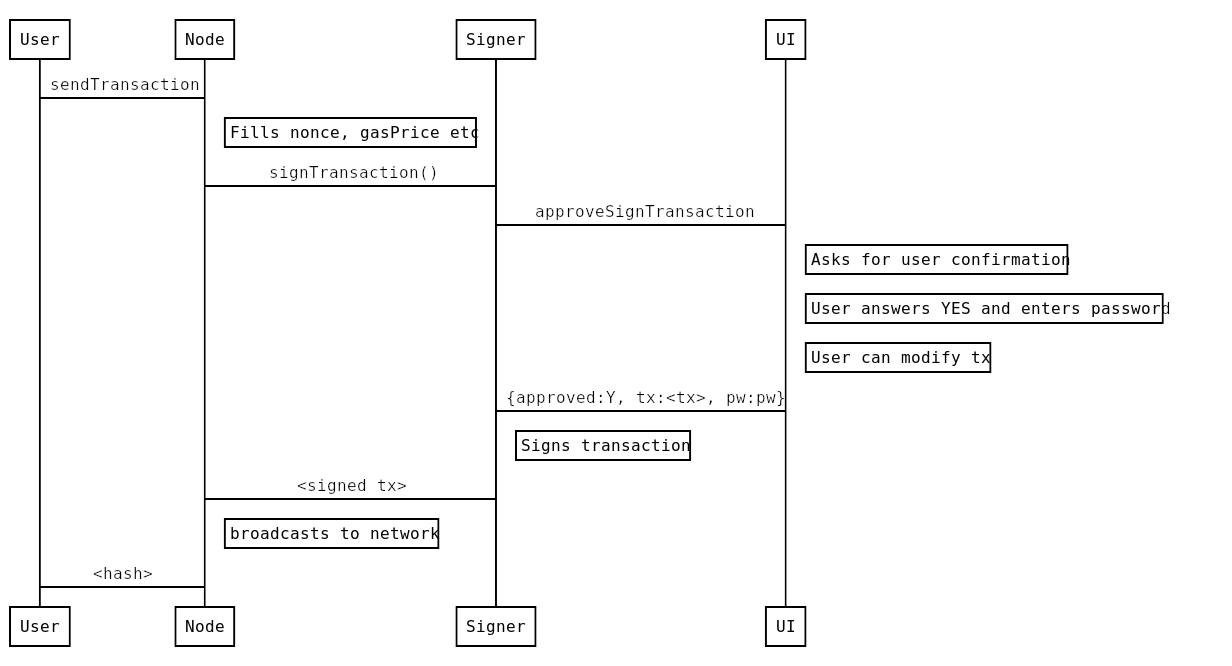
In this case, geth would be started with --signer http://localhost:8550 and would relay requests to eth.sendTransaction.
TODOs
Some snags and todos
-
Clef should take a startup param "--no-change", for UIs that do not contain the capability to perform changes to things, only approve/deny. Such a UI should be able to start the signer in a more secure mode by telling it that it only wants approve/deny capabilities.
-
It would be nice if Clef could collect new 4byte-id:s/method selectors, and have a secondary database for those (
4byte_custom.json). Users could then (optionally) submit their collections for inclusion upstream. -
It should be possible to configure Clef to check if an account is indeed known to it, before passing on to the UI. The reason it currently does not, is that it would make it possible to enumerate accounts if it immediately returned "unknown account" (side channel attack).
-
It should be possible to configure Clef to auto-allow listing (certain) accounts, instead of asking every time.
-
Done Upon startup, Clef should spit out some info to the caller (particularly important when executed in
stdio-ui-mode), invoking methods with the following info:- Version info about the signer
- Address of API (HTTP/IPC)
- List of known accounts
-
Have a default timeout on signing operations, so that if the user has not answered within e.g. 60 seconds, the request is rejected.
-
account_signRawTransaction -
account_bulkSignTransactions([] transactions)should- only exist if enabled via config/flag
- only allow non-data-sending transactions
- all txs must use the same
from-account - let the user confirm, showing
- the total amount
- the number of unique recipients
-
Geth todos
- The signer should pass the
Originheader as call-info to the UI. As of right now, the way that info about the request is put together is a bit of a hack into the HTTP server. This could probably be greatly improved. - Relay: Geth should be started in
geth --signer localhost:8550. - Currently, the Geth APIs use
common.Addressin the arguments to transaction submission (e.gtofield). This type is 20bytes, and is incapable of carrying checksum information. The signer usescommon.MixedcaseAddress, which retains the original input. - The Geth API should switch to use the same type, and relay
to-account verbatim to the external API.
- The signer should pass the
-
Storage
- An encrypted key-value storage should be implemented.
- See rules.md for more info about this.
-
Another potential thing to introduce is pairing.
- To prevent spurious requests which users just accept, implement a way to "pair" the caller with the signer (external API).
- Thus Geth/cpp would cryptographically handshake and afterwards the caller would be allowed to make signing requests.
- This feature would make the addition of rules less dangerous.
-
Wallets / accounts. Add API methods for wallets.
Communication
External API
Clef listens to HTTP requests on http.addr:http.port (or to IPC on ipcpath), with the same JSON-RPC standard as Geth. The messages are expected to be JSON-RPC 2.0 standard.
Some of these calls can require user interaction. Clients must be aware that responses may be delayed significantly or may never be received if a user decides to ignore the confirmation request.
The External API is untrusted: it does not accept credentials, nor does it expect that requests have any authority.
Internal UI API
Clef has one native console-based UI, for operation without any standalone tools. However, there is also an API to communicate with an external UI. To enable that UI, the signer needs to be executed with the --stdio-ui option, which allocates stdin / stdout for the UI API.
An example (insecure) proof-of-concept of has been implemented in pythonsigner.py.
The model is as follows:
- The user starts the UI app (
pythonsigner.py). - The UI app starts
clefwith--stdio-ui, and listens to the process output for confirmation-requests. clefopens the external HTTP API.- When the
signerreceives requests, it sends a JSON-RPC request viastdout. - The UI app prompts the user accordingly, and responds to
clef. clefsigns (or not), and responds to the original request.
External API
See the external API changelog for information about changes to this API.
Encoding
- number: positive integers that are hex encoded
- data: hex encoded data
- string: ASCII string
All hex encoded values must be prefixed with 0x.
account_new
Create new password protected account
The signer will generate a new private key, encrypt it according to web3 keystore spec and store it in the keystore directory.
The client is responsible for creating a backup of the keystore. If the keystore is lost there is no method of retrieving lost accounts.
Arguments
None
Result
- address [string]: account address that is derived from the generated key
Sample call
{
  "id": 0,
  "jsonrpc": "2.0",
  "method": "account_new",
  "params": []
}
Response
{
  "id": 0,
  "jsonrpc": "2.0",
  "result": "0xbea9183f8f4f03d427f6bcea17388bdff1cab133"
}
account_list
List available accounts
List all accounts that this signer currently manages
Arguments
None
Result
- array with account records:
- account.address [string]: account address that is derived from the generated key
Sample call
{
  "id": 1,
  "jsonrpc": "2.0",
  "method": "account_list"
}
Response
{
  "id": 1,
  "jsonrpc": "2.0",
  "result": [
    "0xafb2f771f58513609765698f65d3f2f0224a956f",
    "0xbea9183f8f4f03d427f6bcea17388bdff1cab133"
  ]
}
account_signTransaction
Sign transactions
Signs a transaction and responds with the signed transaction in RLP-encoded and JSON forms.
Arguments
- transaction object:
from[address]: account to send the transaction fromto[address]: receiver account. If omitted or0x, will cause contract creation.gas[number]: maximum amount of gas to burngasPrice[number]: gas pricevalue[number:optional]: amount of Wei to send with the transactiondata[data:optional]: input datanonce[number]: account nonce
- method signature [string:optional]
- The method signature, if present, is to aid decoding the calldata. Should consist of
methodname(paramtype,...), e.g.transfer(uint256,address). The signer may use this data to parse the supplied calldata, and show the user. The data, however, is considered totally untrusted, and reliability is not expected.
- The method signature, if present, is to aid decoding the calldata. Should consist of
Result
- raw [data]: signed transaction in RLP encoded form
- tx [json]: signed transaction in JSON form
Sample call
{
  "id": 2,
  "jsonrpc": "2.0",
  "method": "account_signTransaction",
  "params": [
    {
      "from": "0x1923f626bb8dc025849e00f99c25fe2b2f7fb0db",
      "gas": "0x55555",
      "gasPrice": "0x1234",
      "input": "0xabcd",
      "nonce": "0x0",
      "to": "0x07a565b7ed7d7a678680a4c162885bedbb695fe0",
      "value": "0x1234"
    }
  ]
}
Response
{
  "jsonrpc": "2.0",
  "id": 2,
  "result": {
    "raw": "0xf88380018203339407a565b7ed7d7a678680a4c162885bedbb695fe080a44401a6e4000000000000000000000000000000000000000000000000000000000000001226a0223a7c9bcf5531c99be5ea7082183816eb20cfe0bbc322e97cc5c7f71ab8b20ea02aadee6b34b45bb15bc42d9c09de4a6754e7000908da72d48cc7704971491663",
    "tx": {
      "nonce": "0x0",
      "gasPrice": "0x1234",
      "gas": "0x55555",
      "to": "0x07a565b7ed7d7a678680a4c162885bedbb695fe0",
      "value": "0x1234",
      "input": "0xabcd",
      "v": "0x26",
      "r": "0x223a7c9bcf5531c99be5ea7082183816eb20cfe0bbc322e97cc5c7f71ab8b20e",
      "s": "0x2aadee6b34b45bb15bc42d9c09de4a6754e7000908da72d48cc7704971491663",
      "hash": "0xeba2df809e7a612a0a0d444ccfa5c839624bdc00dd29e3340d46df3870f8a30e"
    }
  }
}
Sample call with ABI-data
{
  "id": 67,
  "jsonrpc": "2.0",
  "method": "account_signTransaction",
  "params": [
    {
      "from": "0x694267f14675d7e1b9494fd8d72fefe1755710fa",
      "gas": "0x333",
      "gasPrice": "0x1",
      "nonce": "0x0",
      "to": "0x07a565b7ed7d7a678680a4c162885bedbb695fe0",
      "value": "0x0",
      "data": "0x4401a6e40000000000000000000000000000000000000000000000000000000000000012"
    },
    "safeSend(address)"
  ]
}
Response
{
  "jsonrpc": "2.0",
  "id": 67,
  "result": {
    "raw": "0xf88380018203339407a565b7ed7d7a678680a4c162885bedbb695fe080a44401a6e4000000000000000000000000000000000000000000000000000000000000001226a0223a7c9bcf5531c99be5ea7082183816eb20cfe0bbc322e97cc5c7f71ab8b20ea02aadee6b34b45bb15bc42d9c09de4a6754e7000908da72d48cc7704971491663",
    "tx": {
      "nonce": "0x0",
      "gasPrice": "0x1",
      "gas": "0x333",
      "to": "0x07a565b7ed7d7a678680a4c162885bedbb695fe0",
      "value": "0x0",
      "input": "0x4401a6e40000000000000000000000000000000000000000000000000000000000000012",
      "v": "0x26",
      "r": "0x223a7c9bcf5531c99be5ea7082183816eb20cfe0bbc322e97cc5c7f71ab8b20e",
      "s": "0x2aadee6b34b45bb15bc42d9c09de4a6754e7000908da72d48cc7704971491663",
      "hash": "0xeba2df809e7a612a0a0d444ccfa5c839624bdc00dd29e3340d46df3870f8a30e"
    }
  }
}
Bash example:
> curl -H "Content-Type: application/json" -X POST --data '{"jsonrpc":"2.0","method":"account_signTransaction","params":[{"from":"0x694267f14675d7e1b9494fd8d72fefe1755710fa","gas":"0x333","gasPrice":"0x1","nonce":"0x0","to":"0x07a565b7ed7d7a678680a4c162885bedbb695fe0", "value":"0x0", "data":"0x4401a6e40000000000000000000000000000000000000000000000000000000000000012"},"safeSend(address)"],"id":67}' http://localhost:8550/

{"jsonrpc":"2.0","id":67,"result":{"raw":"0xf88380018203339407a565b7ed7d7a678680a4c162885bedbb695fe080a44401a6e4000000000000000000000000000000000000000000000000000000000000001226a0223a7c9bcf5531c99be5ea7082183816eb20cfe0bbc322e97cc5c7f71ab8b20ea02aadee6b34b45bb15bc42d9c09de4a6754e7000908da72d48cc7704971491663","tx":{"nonce":"0x0","gasPrice":"0x1","gas":"0x333","to":"0x07a565b7ed7d7a678680a4c162885bedbb695fe0","value":"0x0","input":"0x4401a6e40000000000000000000000000000000000000000000000000000000000000012","v":"0x26","r":"0x223a7c9bcf5531c99be5ea7082183816eb20cfe0bbc322e97cc5c7f71ab8b20e","s":"0x2aadee6b34b45bb15bc42d9c09de4a6754e7000908da72d48cc7704971491663","hash":"0xeba2df809e7a612a0a0d444ccfa5c839624bdc00dd29e3340d46df3870f8a30e"}}}
account_signData
Sign data
Signs a chunk of data and returns the calculated signature.
Arguments
- content type [string]: type of signed data
text/validator: hex data with custom validator defined in a contractapplication/clique: clique headerstext/plain: simple hex data validated byaccount_ecRecover
- account [address]: account to sign with
- data [object]: data to sign
Result
- calculated signature [data]
Sample call
{
  "id": 3,
  "jsonrpc": "2.0",
  "method": "account_signData",
  "params": [
    "data/plain",
    "0x1923f626bb8dc025849e00f99c25fe2b2f7fb0db",
    "0xaabbccdd"
  ]
}
Response
{
  "id": 3,
  "jsonrpc": "2.0",
  "result": "0x5b6693f153b48ec1c706ba4169960386dbaa6903e249cc79a8e6ddc434451d417e1e57327872c7f538beeb323c300afa9999a3d4a5de6caf3be0d5ef832b67ef1c"
}
account_signTypedData
Sign data
Signs a chunk of structured data conformant to EIP-712 and returns the calculated signature.
Arguments
- account [address]: account to sign with
- data [object]: data to sign
Result
- calculated signature [data]
Sample call
{
  "id": 68,
  "jsonrpc": "2.0",
  "method": "account_signTypedData",
  "params": [
    "0xcd2a3d9f938e13cd947ec05abc7fe734df8dd826",
    {
      "types": {
        "EIP712Domain": [
          {
            "name": "name",
            "type": "string"
          },
          {
            "name": "version",
            "type": "string"
          },
          {
            "name": "chainId",
            "type": "uint256"
          },
          {
            "name": "verifyingContract",
            "type": "address"
          }
        ],
        "Person": [
          {
            "name": "name",
            "type": "string"
          },
          {
            "name": "wallet",
            "type": "address"
          }
        ],
        "Mail": [
          {
            "name": "from",
            "type": "Person"
          },
          {
            "name": "to",
            "type": "Person"
          },
          {
            "name": "contents",
            "type": "string"
          }
        ]
      },
      "primaryType": "Mail",
      "domain": {
        "name": "Ether Mail",
        "version": "1",
        "chainId": 1,
        "verifyingContract": "0xCcCCccccCCCCcCCCCCCcCcCccCcCCCcCcccccccC"
      },
      "message": {
        "from": {
          "name": "Cow",
          "wallet": "0xCD2a3d9F938E13CD947Ec05AbC7FE734Df8DD826"
        },
        "to": {
          "name": "Bob",
          "wallet": "0xbBbBBBBbbBBBbbbBbbBbbbbBBbBbbbbBbBbbBBbB"
        },
        "contents": "Hello, Bob!"
      }
    }
  ]
}
Response
{
    "id": 1,
    "jsonrpc": "2.0",
    "result": "0x4355c47d63924e8a72e509b65029052eb6c299d53a04e167c5775fd466751c9d07299936d304c153f6443dfa05f40ff007d72911b6f72307f996231605b915621c"
}
account_ecRecover
Recover the signing address
Derive the address from the account that was used to sign data with content type text/plain and the signature.
Arguments
- data [data]: data that was signed
- signature [data]: the signature to verify
Result
- derived account [address]
Sample call
{
  "id": 4,
  "jsonrpc": "2.0",
  "method": "account_ecRecover",
  "params": [
    "0xaabbccdd",
    "0x5b6693f153b48ec1c706ba4169960386dbaa6903e249cc79a8e6ddc434451d417e1e57327872c7f538beeb323c300afa9999a3d4a5de6caf3be0d5ef832b67ef1c"
  ]
}
Response
{
  "id": 4,
  "jsonrpc": "2.0",
  "result": "0x1923f626bb8dc025849e00f99c25fe2b2f7fb0db"
}
account_version
Get external API version
Get the version of the external API used by Clef.
Arguments
None
Result
- external API version [string]
Sample call
{
  "id": 0,
  "jsonrpc": "2.0",
  "method": "account_version",
  "params": []
}
Response
{
    "id": 0,
    "jsonrpc": "2.0",
    "result": "6.0.0"
}
UI API
These methods needs to be implemented by a UI listener.
By starting the signer with the switch --stdio-ui-test, the signer will invoke all known methods, and expect the UI to respond with
denials. This can be used during development to ensure that the API is (at least somewhat) correctly implemented.
See pythonsigner, which can be invoked via python3 pythonsigner.py test to perform the 'denial-handshake-test'.
All methods in this API use object-based parameters, so that there can be no mixup of parameters: each piece of data is accessed by key.
See the ui API changelog for information about changes to this API.
OBS! A slight deviation from json standard is in place: every request and response should be confined to a single line.
Whereas the json specification allows for linebreaks, linebreaks should not be used in this communication channel, to make
things simpler for both parties.
ApproveTx / ui_approveTx
Invoked when there's a transaction for approval.
Sample call
Here's a method invocation:
curl -i -H "Content-Type: application/json" -X POST --data '{"jsonrpc":"2.0","method":"account_signTransaction","params":[{"from":"0x694267f14675d7e1b9494fd8d72fefe1755710fa","gas":"0x333","gasPrice":"0x1","nonce":"0x0","to":"0x07a565b7ed7d7a678680a4c162885bedbb695fe0", "value":"0x0", "data":"0x4401a6e40000000000000000000000000000000000000000000000000000000000000012"},"safeSend(address)"],"id":67}' http://localhost:8550/
Results in the following invocation on the UI:
{
  "jsonrpc": "2.0",
  "id": 1,
  "method": "ui_approveTx",
  "params": [
    {
      "transaction": {
        "from": "0x0x694267f14675d7e1b9494fd8d72fefe1755710fa",
        "to": "0x0x07a565b7ed7d7a678680a4c162885bedbb695fe0",
        "gas": "0x333",
        "gasPrice": "0x1",
        "value": "0x0",
        "nonce": "0x0",
        "data": "0x4401a6e40000000000000000000000000000000000000000000000000000000000000012",
        "input": null
      },
      "call_info": [
          {
            "type": "WARNING",
            "message": "Invalid checksum on to-address"
          },
          {
            "type": "Info",
            "message": "safeSend(address: 0x0000000000000000000000000000000000000012)"
          }
        ],
      "meta": {
        "remote": "127.0.0.1:48486",
        "local": "localhost:8550",
        "scheme": "HTTP/1.1"
      }
    }
  ]
}
The same method invocation, but with invalid data:
curl -i -H "Content-Type: application/json" -X POST --data '{"jsonrpc":"2.0","method":"account_signTransaction","params":[{"from":"0x694267f14675d7e1b9494fd8d72fefe1755710fa","gas":"0x333","gasPrice":"0x1","nonce":"0x0","to":"0x07a565b7ed7d7a678680a4c162885bedbb695fe0", "value":"0x0", "data":"0x4401a6e40000000000000002000000000000000000000000000000000000000000000012"},"safeSend(address)"],"id":67}' http://localhost:8550/
{
  "jsonrpc": "2.0",
  "id": 1,
  "method": "ui_approveTx",
  "params": [
    {
      "transaction": {
        "from": "0x0x694267f14675d7e1b9494fd8d72fefe1755710fa",
        "to": "0x0x07a565b7ed7d7a678680a4c162885bedbb695fe0",
        "gas": "0x333",
        "gasPrice": "0x1",
        "value": "0x0",
        "nonce": "0x0",
        "data": "0x4401a6e40000000000000002000000000000000000000000000000000000000000000012",
        "input": null
      },
      "call_info": [
          {
            "type": "WARNING",
            "message": "Invalid checksum on to-address"
          },
          {
            "type": "WARNING",
            "message": "Transaction data did not match ABI-interface: WARNING: Supplied data is stuffed with extra data. \nWant 0000000000000002000000000000000000000000000000000000000000000012\nHave 0000000000000000000000000000000000000000000000000000000000000012\nfor method safeSend(address)"
          }
        ],
      "meta": {
        "remote": "127.0.0.1:48492",
        "local": "localhost:8550",
        "scheme": "HTTP/1.1"
      }
    }
  ]
}
One which has missing to, but with no data:
{
  "jsonrpc": "2.0",
  "id": 3,
  "method": "ui_approveTx",
  "params": [
    {
      "transaction": {
        "from": "",
        "to": null,
        "gas": "0x0",
        "gasPrice": "0x0",
        "value": "0x0",
        "nonce": "0x0",
        "data": null,
        "input": null
      },
      "call_info": [
          {
            "type": "CRITICAL",
            "message": "Tx will create contract with empty code!"
          }
        ],
      "meta": {
        "remote": "signer binary",
        "local": "main",
        "scheme": "in-proc"
      }
    }
  ]
}
ApproveListing / ui_approveListing
Invoked when a request for account listing has been made.
Sample call
{
  "jsonrpc": "2.0",
  "id": 5,
  "method": "ui_approveListing",
  "params": [
    {
      "accounts": [
        {
          "url": "keystore:///home/bazonk/.ethereum/keystore/UTC--2017-11-20T14-44-54.089682944Z--123409812340981234098123409812deadbeef42",
          "address": "0x123409812340981234098123409812deadbeef42"
        },
        {
          "url": "keystore:///home/bazonk/.ethereum/keystore/UTC--2017-11-23T21-59-03.199240693Z--cafebabedeadbeef34098123409812deadbeef42",
          "address": "0xcafebabedeadbeef34098123409812deadbeef42"
        }
      ],
      "meta": {
        "remote": "signer binary",
        "local": "main",
        "scheme": "in-proc"
      }
    }
  ]
}
ApproveSignData / ui_approveSignData
Sample call
{
  "jsonrpc": "2.0",
  "id": 4,
  "method": "ui_approveSignData",
  "params": [
    {
      "address": "0x123409812340981234098123409812deadbeef42",
      "raw_data": "0x01020304",
      "messages": [
        {
          "name": "message",
          "value": "\u0019Ethereum Signed Message:\n4\u0001\u0002\u0003\u0004",
          "type": "text/plain"
        }
      ],
      "hash": "0x7e3a4e7a9d1744bc5c675c25e1234ca8ed9162bd17f78b9085e48047c15ac310",
      "meta": {
        "remote": "signer binary",
        "local": "main",
        "scheme": "in-proc"
      }
    }
  ]
}
ApproveNewAccount / ui_approveNewAccount
Invoked when a request for creating a new account has been made.
Sample call
{
  "jsonrpc": "2.0",
  "id": 4,
  "method": "ui_approveNewAccount",
  "params": [
    {
      "meta": {
        "remote": "signer binary",
        "local": "main",
        "scheme": "in-proc"
      }
    }
  ]
}
ShowInfo / ui_showInfo
The UI should show the info (a single message) to the user. Does not expect response.
Sample call
{
  "jsonrpc": "2.0",
  "id": 9,
  "method": "ui_showInfo",
  "params": [
    "Tests completed"
  ]
}
ShowError / ui_showError
The UI should show the error (a single message) to the user. Does not expect response.
{
  "jsonrpc": "2.0",
  "id": 2,
  "method": "ui_showError",
  "params": [
    "Something bad happened!"
  ]
}
OnApprovedTx / ui_onApprovedTx
OnApprovedTx is called when a transaction has been approved and signed. The call contains the return value that will be sent to the external caller. The return value from this method is ignored - the reason for having this callback is to allow the ruleset to keep track of approved transactions.
When implementing rate-limited rules, this callback should be used.
TLDR; Use this method to keep track of signed transactions, instead of using the data in ApproveTx.
Example call:
{
  "jsonrpc": "2.0",
  "id": 1,
  "method": "ui_onApprovedTx",
  "params": [
    {
      "raw": "0xf88380018203339407a565b7ed7d7a678680a4c162885bedbb695fe080a44401a6e4000000000000000000000000000000000000000000000000000000000000001226a0223a7c9bcf5531c99be5ea7082183816eb20cfe0bbc322e97cc5c7f71ab8b20ea02aadee6b34b45bb15bc42d9c09de4a6754e7000908da72d48cc7704971491663",
      "tx": {
        "nonce": "0x0",
        "gasPrice": "0x1",
        "gas": "0x333",
        "to": "0x07a565b7ed7d7a678680a4c162885bedbb695fe0",
        "value": "0x0",
        "input": "0x4401a6e40000000000000000000000000000000000000000000000000000000000000012",
        "v": "0x26",
        "r": "0x223a7c9bcf5531c99be5ea7082183816eb20cfe0bbc322e97cc5c7f71ab8b20e",
        "s": "0x2aadee6b34b45bb15bc42d9c09de4a6754e7000908da72d48cc7704971491663",
        "hash": "0xeba2df809e7a612a0a0d444ccfa5c839624bdc00dd29e3340d46df3870f8a30e"
      }
    }
  ]
}
OnSignerStartup / ui_onSignerStartup
This method provides the UI with information about what API version the signer uses (both internal and external) as well as build-info and external API, in k/v-form.
Example call:
{
  "jsonrpc": "2.0",
  "id": 1,
  "method": "ui_onSignerStartup",
  "params": [
    {
      "info": {
        "extapi_http": "http://localhost:8550",
        "extapi_ipc": null,
        "extapi_version": "2.0.0",
        "intapi_version": "1.2.0"
      }
    }
  ]
}
OnInputRequired / ui_onInputRequired
Invoked when Clef requires user input (e.g. a password).
Example call:
{
  "jsonrpc": "2.0",
  "id": 1,
  "method": "ui_onInputRequired",
  "params": [
    {
      "title": "Account password",
      "prompt": "Please enter the password for account 0x694267f14675d7e1b9494fd8d72fefe1755710fa",
      "isPassword": true
    }
  ]
}
Rules for UI apis
A UI should conform to the following rules.
- A UI MUST NOT load any external resources that were not embedded/part of the UI package.
- For example, not load icons, stylesheets from the internet
- Not load files from the filesystem, unless they reside in the same local directory (e.g. config files)
- A Graphical UI MUST show the blocky-identicon for ethereum addresses.
- A UI MUST warn display appropriate warning if the destination-account is formatted with invalid checksum.
- A UI MUST NOT open any ports or services
- The signer opens the public port
- A UI SHOULD verify the permissions on the signer binary, and refuse to execute or warn if permissions allow non-user write.
- A UI SHOULD inform the user about the
SHA256orMD5hash of the binary being executed - A UI SHOULD NOT maintain a secondary storage of data, e.g. list of accounts
- The signer provides accounts
- A UI SHOULD, to the best extent possible, use static linking / bundling, so that required libraries are bundled along with the UI.
UI Implementations
There are a couple of implementation for a UI. We'll try to keep this list up to date.
| Name | Repo | UI type | No external resources | Blocky support | Verifies permissions | Hash information | No secondary storage | Statically linked | Can modify parameters |
|---|---|---|---|---|---|---|---|---|---|
| QtSigner | https://github.com/holiman/qtsigner/ | Python3/QT-based | 👍 | 👍 | 👍 | 👍 | 👍 | ❌ | 👍 (partially) |
| GtkSigner | https://github.com/holiman/gtksigner | Python3/GTK-based | 👍 | ❌ | ❌ | 👍 | 👍 | ❌ | ❌ |
| Frame | https://github.com/floating/frame/commits/go-signer | Electron-based | ❌ | ❌ | ❌ | ❌ | ? | ❌ | ❌ |
| Clef UI | https://github.com/ethereum/clef-ui | Golang/QT-based | 👍 | 👍 | ❌ | 👍 | 👍 | ❌ | 👍 (approve tx only) |